
Call us: +919217844785
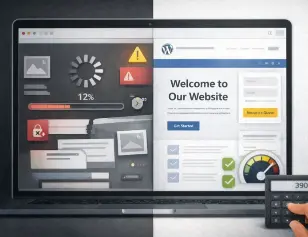

Every small business owner wants to save money. That’s normal.
But when it comes to websites, cutting costs too aggressively is one of the most expensive mistakes you can make.
If you’re wondering why cheap websites fail, the answer is simple:
👉 They are built to exist, not to perform.
Cheap websites don’t fail immediately.
They fail silently—by not ranking, not converting, and not building trust.
This article breaks down exactly why cheap websites fail, how they hurt small businesses, and what you should do instead.
Table of Contents
What Is Considered a “Cheap Website”?
Let’s be clear.
A cheap website is not affordable.
A cheap website is one that’s built without strategy, quality, or long-term thinking.
Typically, cheap websites:
- They are priced unusually low
- Rely on generic templates
- Skip SEO fundamentals
- Use copied or AI-dumped content
- Have no conversion structure
- Offer no post-launch support
Now, let’s get into why cheap websites fail in real-world scenarios.
1. Cheap Websites Fail Because They Look Untrustworthy
First impressions matter.
Visitors judge your business in 3–5 seconds.
Cheap websites often have:
- Generic layouts
- Poor typography
- Low-quality images
- Inconsistent branding
Result?
Visitors assume:
- You’re inexperienced
- You’re not serious
- You’re not trustworthy
This is one of the biggest reasons why cheap websites fail—they damage credibility before you even get a chance.
2. Cheap Websites Fail at Lead Generation
A website’s job is not to exist.
It’s to convert visitors into inquiries.
Cheap websites usually lack:
- Clear call-to-actions
- Logical page flow
- Conversion-focused layout
- User journey planning
So even if traffic comes in, nothing happens.
No calls.
No forms.
No leads.
That’s a silent failure—and one of the most dangerous ones.
3. Poor SEO Is a Core Reason Why Cheap Websites Fail
SEO is not optional anymore.
Cheap websites often:
- Ignore on-page SEO
- Have no keyword strategy
- Use bloated themes
- Load slowly
- Miss technical SEO basics
As a result:
- Google doesn’t rank them
- Organic traffic never grows
- Business stays invisible
If your website can’t be found, it’s useless.
That’s exactly why cheap websites fail in competitive markets.
4. Cheap Websites Use Generic, Non-Persuasive Content
Content is not filler.
It’s persuasion.
Cheap websites usually include:
- Copied text
- Generic “About Us” pages
- Vague service descriptions
- No customer-focused messaging
This creates confusion.
Visitors don’t understand:
- What you actually do
- Who your services are for
- Why they should choose you
Confused visitors don’t convert.
5. Cheap Websites Are Slow and Technically Weak
Speed affects:
- User experience
- SEO rankings
- Conversion rates
Cheap websites often suffer from:
- Heavy themes
- Unoptimized images
- No caching
- Poor hosting
A slow website increases bounce rate and kills trust.
Google also penalizes slow sites.
Another solid reason why cheap websites fail.
6. No Scalability = Future Failure
Cheap websites are built for “now,” not “next.”
Problems you’ll face later:
- Hard to add new pages
- Difficult to integrate tools
- Limited SEO growth
- Design breaks during updates
Eventually, you’ll hear this sentence:
“We need to rebuild the website.”
That rebuild costs more than doing it right the first time.
7. Cheap Websites Lack Strategy
Strategy is invisible—but essential.
Cheap websites don’t consider:
- Business goals
- Target audience
- Customer journey
- Sales funnel
- Long-term growth
Without a strategy, a website is just decoration.
This is the core reason why cheap websites fail—they’re built without purpose.
The Real Cost of a Cheap Website
Let’s talk numbers.
A cheap website might cost ₹10,000 upfront.
But hidden costs include
- Lost leads
- Lost credibility
- Lost rankings
- Rebuild costs
- Missed opportunities
In reality, cheap websites cost more over time.
Cheap vs Affordable: Know the Difference
Affordable websites:
- Are strategically planned
- Use proven structures
- Focus on results
- Scale with business growth
Cheap websites:
- Cut corners
- Ignore fundamentals
- Focus only on launch
- Fail quietly
If you’re choosing between cheap and effective, always choose effective.
When a Cheap Website Might Be “Okay”
Let’s be honest.
A cheap website may work if:
- You only need an online presence
- You don’t need leads
- You don’t care about SEO
- You plan to rebuild soon anyway
But if your website is meant to support business growth, cheap is the wrong choice.
What to Do Instead of Choosing Cheap
If the budget is limited:
- Start small, but strategic
- Build fewer pages, but better ones
- Focus on core services
- Plan for SEO from day one
- Use a scalable WordPress setup
Smart planning beats cheap execution.
Final Thoughts
If you’re serious about growth, understand this:
Cheap websites don’t fail because they’re inexpensive.
They fail because they ignore everything that makes a website work.
Now you clearly know why cheap websites fail—and how to avoid making that mistake.
Want a Website That Actually Works?
At Backend Spark, we help small businesses:
- Avoid cheap website traps
- Build strategic WordPress websites
- Generate leads, not just pages
- Grow with SEO and content
👉 Request a free website audit and find out whether your current website is helping or hurting your business.
I hope you enjoy this post, and if you want to receive future updates, please follow Backend Spark on Facebook and Instagram.